Storm Charles Cancels Most Lisbon Flights as Red Rain Alert Stays
Storm Charles prompted a red rain warning and most flights cancelled at Lisbon airport on Nov. 11, while IPMA cut wind alerts to orange.

Storm Charles brought flooded streets, a red rain warning and almost total flight cancellations to Lisbon on Wednesday, Nov. 11. Portugal’s weather institute, the Instituto Português do Mar e da Atmosfera (IPMA), lowered its wind warning for Lisbon, Setúbal and Beja from red to orange that morning, but the red warning for rain stayed in place.
According to Observador, the depression changed course during the night and may now enter mainland Portugal further south than first forecast. The country has been on alert since midnight.
What the first overnight count shows
The national emergency and civil protection authority (Autoridade Nacional de Emergência e Proteção Civil) recorded 60 incidents between midnight and 06:00, according to commander José Miranda, quoted by Lusa. Of those, 49 were floods, four were fallen trees, four were road clearances, one was a collapsed structure and two were landslides or similar ground movements.
The Greater Lisbon area was the most affected with 26 incidents, followed by the Setúbal Peninsula with 21. In total, 211 emergency personnel were deployed. There were no casualties and no reported damage at that point. Rain was expected to become heavier and more persistent through 18:00 before easing on Thursday.
The storm hit Madeira first. Civil protection said it had less impact there than expected, even though gusts reached 130 km/h and there were well over a hundred incidents, none of them significant.
Airport and road disruption
At Lisbon’s Humberto Delgado airport, almost every flight on the departures board at Terminal 1 was cancelled from 11:00 onward, a reporter said on the broadcast. The day before, the airport operator ANA had said about 40 flights across mainland Portugal would be cancelled on Wednesday. The number rose sharply as the storm approached. ANA had advised passengers to check their flights in advance.
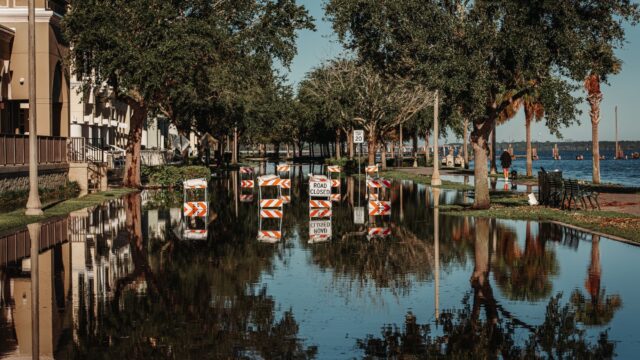
Near the Oriente rail and bus station, several cars were partly submerged by urban flooding, including a jeep. Flixbus services there were completely stopped, and Rede Expressos had also announced disruptions. Traffic on the CRIL and the Segunda Circular was light.
About two thousand customers of the power distributor E-Redes were without electricity at 7 a.m., the company said in a statement.
Downtown Lisbon and the Rossio Christmas market
On Rua Augusta, which is normally busy, a reporter found very few people. Some shops were closed and others had two or three customers. Sandbags were stacked at some doors to keep floodwater out, and no terraces were set up. Schools and universities were closed, and traffic around Rossio was far below normal.
Workers from a kiosk rental company, around 10 of them and not city employees according to one of them, were still assembling the Christmas market stalls at Praça Dom Pedro IV in the rain.
Leiria prepares 10 months after the last storm
The Leiria region was again under a red warning. Mayor Gonçalo Lopes said the municipality had recorded no incidents since midnight and that the rain was not heavy. Teams were monitoring the Lis river for a rise in flow, and the most critical points had been identified.
Lopes said civil protection now has more water pumps, generators and Starlink satellite connections, an emergency network built after the storm of 10 months ago. Some homes and cliffs damaged then are still being monitored. He called heavy rain “the new normal.”
What this means for residents
For people in Lisbon, the warnings meant closed schools and universities, cancelled flights and long-distance bus services, and streets with standing water. IPMA’s downgrade of the wind warning does not apply to rain, which stayed red.
What happens next
Civil protection said conditions are expected to calm on Thursday. In Leiria, Lopes said the focus for Wednesday and Thursday is clearing debris such as displaced earth and collapsed road sections.
Source: Observador
Site editor: Nikita Sheikin