Permanent Residence in Portugal After 5 Years: Two Routes Compared
Five years on a temporary card opens two doors at AIMA. One is Portugal's own permanent permit, the other is an EU status that travels better, and they test different things.
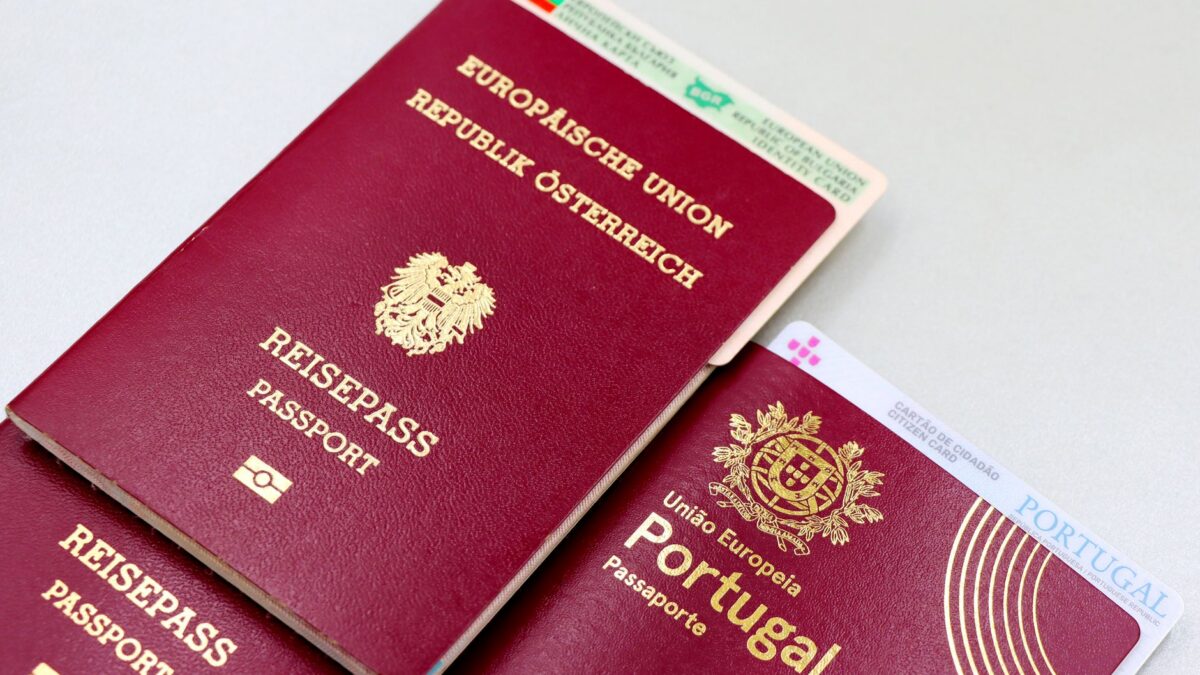
After five years of legal residence in Portugal, a non-EU citizen can apply to AIMA for either a permanent residence permit (autorização de residência permanente) under article 80 of Law 23/2007 or EU long-term resident status (Estatuto de Residente de Longa Duração, ERLD). The permanent permit requires basic Portuguese at A2 level; the EU status focuses on stable income and health insurance.
AIMA (Agência para a Integração, Migrações e Asilo) handles both. Requirements and fees below are as of November 2026, from AIMA’s own pages and fee table. They are general information: for your own file, speak to AIMA or an immigration lawyer (advogado).
What is the difference between the two statuses?
The permanent permit is a Portuguese national status, while the ERLD comes from EU rules on long-term residents and is recognized across the EU. You can hold one or the other depending on which conditions you meet and what you need it for.
| As of November 2026 | Permanent residence permit (art. 80) | EU long-term resident status (ERLD) |
|---|---|---|
| Residence needed | A temporary residence permit held for at least 5 years | Legal and uninterrupted residence in the 5 years right before applying |
| Language | Proof of basic Portuguese (A2 or equivalent) | Not listed by AIMA for this status |
| Money | Proof of means of subsistence, taxes and Social Security in order | Stable and regular resources for you and your family, without social assistance |
| Health cover | Not listed on AIMA’s page | Health insurance covering the risks covered for nationals |
| Criminal record | No sentence or sentences over 1 year of prison in the last 5 years | No threat to public order or public security |
| How to ask | Appointment requested by email, then in person at an AIMA office | Appointment form on AIMA’s contact website |
Who qualifies for a permanent residence permit?
You qualify if you have held a temporary residence permit for at least five years and meet the other legal conditions. AIMA’s page on the permanent residence permit under article 80 lists what to bring:
- a valid passport or travel document;
- proof of means of subsistence;
- a sworn statement of your address saying how you live there (owner, tenant, subtenant and so on), with the land registry certificate if you own it or a statement from the landlord if you rent;
- proof that your tax and Social Security obligations are up to date;
- proof of basic Portuguese.
The permit is refused if, in your last five years in Portugal, you were sentenced to prison terms that alone or together exceed one year. For serious crimes listed in the law, the rule applies even when the sentence was suspended.
How do I prove A2 Portuguese?
AIMA accepts several documents as proof of basic Portuguese. The most common for adults who learned the language here are a CAPLE certificate and a course certificate.
- A school certificate from a recognized Portuguese school, or from a school in a Portuguese-speaking country.
- A pass certificate from a basic Portuguese course run by IEFP, the public employment and training institute, or by a recognized school.
- A certificate from a test at a CAPLE center (Centro de Avaliação de Português Língua Estrangeira), such as the CIPLE A2 exam.
- A certificate of level A2 or higher in a Portuguese as a Host Language course (Português Língua de Acolhimento), run by public schools, IEFP centers, Qualifica centers or partner organizations.
Our guide to the CIPLE A2 Portuguese exam covers fees, format and where to sit it in Lisbon.
How do I apply for each status?
Both start with a request for an appointment, not with an online application.
- For the permanent permit, email [email protected] with the subject “Agendamento de Concessão/Renovação de AR permanente”, as AIMA’s 2026 FAQ instructs, and wait for a date.
- At the appointment at any AIMA office, hand in the signed form (Modelo 1) and the documents listed above. AIMA can send the file to the office for your area after the decision.
- For EU long-term status, use the appointment form on AIMA’s contact website, which AIMA opened on 19 December 2025. It asks for scans of your residence card, your full passport, your IRS tax returns for the last 5 years and your Social Security contribution record.
- Pay the fees AIMA charges for your request and keep every receipt.
AIMA warns that forms submitted outside the scope of the EU status, or that the bodies it consults cannot validate, are discarded.
How much does it cost and how long is the card valid?
AIMA’s fee table, under Ordinance (Portaria) 307/2023, charges separate amounts for the analysis and for the card itself, with a 25% reduction on a digital channel.
| Fee (as of November 2026) | Standard | Digital channel |
|---|---|---|
| Analysis of a permanent permit request | €133.00 | €99.80 |
| Grant of a permanent residence permit | €351.10 | €263.40 |
| Renewal of a permanent residence card | €61.90 | €46.30 |
| Analysis of an EU long-term status request | €169.20 | €126.90 |
| Issue or renewal of the EU long-term residence card | €160.50 | €120.40 |
According to AIMA, the permanent permit is issued for five years and has no expiry limit as a status, but the card must be renewed every five years or when your identification details change. Since December 2025, AIMA says EU long-term resident cards are renewed on the AIMA Renewals Portal; our guide to renewing a residence permit online explains how that portal works.
How long can I be away without losing it?
A permanent status allows much longer absences than a temporary permit. Under article 85 of Law 23/2007, a permanent permit can be cancelled after an absence of 24 consecutive months or 30 non-consecutive months within three years, compared with 6 consecutive or 8 non-consecutive months for a temporary permit. Check the current text with AIMA or a lawyer before a long stay abroad, because the Foreigners Act has been amended several times since 2023.
Golden visa holders are a special case: AIMA says the permanent investment permit is exempt from the absence rules in article 85. The EU long-term status has its own rules on time spent outside the EU.
Bottom line
Start the A2 certificate a year before your fifth anniversary, since it is the item most likely to hold up a permanent permit, and check your IRS returns for all five years, because the EU status asks for them by scan. Permanent residence does not shorten the wait for citizenship, which since May 2026 runs to 10 years of legal residence for most non-EU nationals; see our guide to Portuguese citizenship requirements.
FAQ
Can I apply for permanent residence before my fifth year ends?
No. AIMA’s list requires a temporary permit held for at least five years. Book the appointment so that the date falls after that point.
Do D7 and digital nomad visa holders qualify?
For the permanent permit, AIMA’s page asks for a temporary residence permit held for at least five years and does not single out particular permit types. Holders still need A2 Portuguese and the other documents.
Can I hold both statuses?
AIMA runs them as separate procedures with separate fees, and its pages do not say whether one person can hold both. Ask AIMA which one fits your plans, especially if you may later move to another EU country.
Do I still need to renew the card?
Yes. The status is permanent, but the card is renewed every five years, or sooner if your name or other details change.