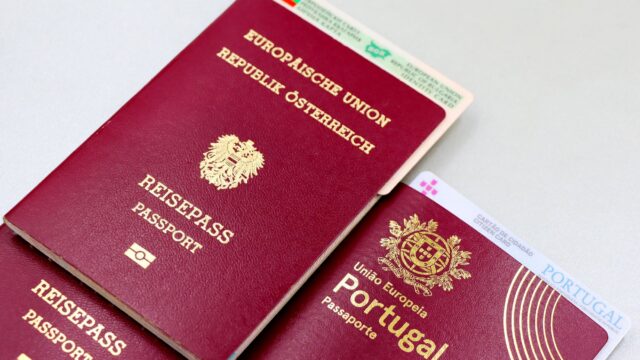
Portuguese Citizenship by Descent: Children and Grandchildren
Having a Portuguese parent is still the simplest way into Portuguese nationality. For grandchildren, the 2026 reform added the tests that naturalization applicants face.
Children of a Portuguese parent born abroad become Portuguese of origin by registering their birth in the Portuguese civil registry, and grandchildren of a Portuguese citizen of origin can claim nationality by declaration. Since Organic Law 1/2026 took effect on 19 May 2026, grandchildren must also prove Portuguese language and culture, civic knowledge and a clean record. The registry service IRN handles both routes.
IRN (Instituto dos Registos e do Notariado, the registry and notary institute) runs nationality cases, not AIMA. The rules below are as of November 2026 and come from the Nationality Law (Law 37/81) as republished with Organic Law 1/2026. They are general information; for your family’s case, ask IRN or a lawyer (advogado).
Who counts as Portuguese by descent?
Article 1 of the Nationality Law lists the people who are Portuguese of origin (portugueses de origem). Two groups matter for families abroad.
| Who (as of November 2026) | Legal basis | What is required |
|---|---|---|
| Child of a Portuguese mother or father, born abroad | Article 1(1)(c) | Birth registered in the Portuguese civil registry, or a declaration that the person wants to be Portuguese |
| Grandchild of a Portuguese citizen of origin who did not lose that nationality | Article 1(1)(d) and 1(3) | A declaration, effective ties to the Portuguese community, and the requirements in article 6(1)(c) to (h) |
| Great-grandchild of a Portuguese citizen of origin | Article 6(8) | Not a descent route: naturalization, which the government may grant after 5 years of legal residence in Portugal |
Nationality obtained under article 1 is original nationality, so it counts from birth. Great-grandchildren acquire nationality by naturalization instead, with a shorter residence period than other foreigners.
How does a child of a Portuguese parent register?
The child’s foreign birth certificate is entered into the Portuguese civil registry, a process people often call transcrição (transcription). Once the birth is registered, the child is Portuguese of origin and can request a citizen card (Cartão de Cidadão) and passport.
- Make sure the Portuguese parent’s own birth is in the Portuguese registry and that the parent held Portuguese nationality when the child was born.
- Get a full copy of the child’s foreign birth certificate showing both parents, apostilled or legalized. Foreign documents must also be translated, unless they are in English, French or Spanish and the registry officer reads that language.
- File at a Portuguese registry office or consulate, or by post. In Portugal, IRN’s nationality desks (Balcão da Nacionalidade) take nationality requests in person.
- Pay the fee, if any, and keep the receipt and process number.
Under IRN’s fee rules (Regulamento Emolumentar dos Registos e do Notariado), the declaration and the birth record that give nationality are free for a minor. For an adult, the procedure to register a birth that happened abroad costs €175, as of November 2026.
What changed for grandchildren in 2026?
Grandchildren keep their route to original nationality, but must now meet most of the naturalization tests. The new article 1(3) requires the conditions in article 6(1)(c) to (h):
- proof, by test or certificate, of sufficient knowledge of Portuguese language and culture, history and national symbols;
- sufficient knowledge of citizens’ fundamental rights and duties and of how the Portuguese state is organized;
- a solemn declaration of adherence to the principles of a democratic state under the rule of law;
- no final sentence of more than 3 years of effective prison for terrorism, violent or highly organized crime, crimes against state security or assisting illegal immigration;
- no threat to national security or defense, and no UN or EU restrictive measures.
The grandparent must have been Portuguese of origin and must not have lost that nationality. Article 1 still lists effective ties to the Portuguese community (laços de efetiva ligação à comunidade nacional) as a condition for grandchildren, alongside the declaration that they want to be Portuguese.
Which documents and tests do I need?
IRN’s guide “Como obter a nacionalidade portuguesa” lists the documents for each type of request. For a grandchild, expect at least the following:
- your foreign birth certificate, and the birth certificates linking you to the Portuguese grandparent, apostilled or legalized and translated where needed;
- the grandparent’s Portuguese birth record;
- criminal record certificates from Portugal, your country of nationality and countries where you lived;
- proof of the language, culture and civics knowledge required by article 6.
How the new culture and civics test works depends on the updated Nationality Regulation, which the government had 90 days from 18 May 2026 to adopt. Check IRN’s page before you book any exam. Under the old rules the CIPLE A2 exam was a common language certificate; see our guide to the CIPLE Portuguese language test.
Where do I apply and how do I follow my case?
You can apply without a representative by post or in person at a nationality desk, according to the Ministry of Justice page on submitting a nationality application. Lawyers and solicitors must file online, which has been mandatory for them since 1 December 2023. IRN’s information line is (+351) 211 950 500.
- Get a Portuguese tax number if a lawyer will file for you or if you need one for payments; see our guide to the NIF tax number.
- File the declaration with all documents and pay the fee.
- Note the process number and access details.
- Follow progress with the “Consultar estado do processo de nacionalidade” service on the justice portal, and answer any request for missing documents by its deadline.
For adults, acquisition by will, adoption or naturalization costs €250 under the same fee rules, as of November 2026.
What about applications filed before 19 May 2026?
Applications pending when the law took effect are decided under the old wording of the Nationality Law, according to article 7 of Organic Law 1/2026. Families that filed earlier keep those rules.
The reform did not change the route for children of a Portuguese parent. For people who are not descendants, see our guide to citizenship by residence, which now takes 7 or 10 years.
Bottom line
Register children while they are minors: the birth record is free, while an adult pays €175 for the same step. Grandchildren should collect the full chain of birth certificates first and then watch for the new regulation, which will set how the culture and civics test is taken.
FAQ
Can a great-grandchild claim Portuguese citizenship from abroad?
No. Great-grandchildren are not Portuguese of origin under article 1. They can ask for naturalization after 5 years of legal residence in Portugal, under article 6(8).
Does my Portuguese parent need to be alive?
Article 1 looks at whether your mother or father was Portuguese, and the registry checks the parent’s own birth record. If your parent has died, ask IRN which extra records it needs for your file.
Do I need to speak Portuguese as a grandchild?
Yes. Since 19 May 2026, grandchildren must prove sufficient Portuguese language and culture by test or certificate. People from Portuguese-speaking countries should ask IRN how this applies to them.
Will I lose my other nationality?
Portugal allows dual nationality. Whether you keep your other passport depends on the law of your other country.