Fado in Lisbon: Fado Museum, Fado Houses and Where to Hear It
Fado in Lisbon centers on Alfama and Mouraria. Fado Museum hours and tickets, Sr. Vinho, murals, Severa's street and where to hear fado vadio.
To hear and understand fado in Lisbon, start at the Museu do Fado in Alfama, then walk through Alfama and Mouraria, the two old quarters most tied to the music, where fado houses and small eateries host singers in the evening. Fado is Lisbon’s own urban song and is classified as intangible cultural heritage. The places below cover the museum, the neighborhoods, the street art and the houses that Lisbon’s tourism board, Visit Lisboa, puts on its fado route.
Museu do Fado, Alfama
The Museu do Fado (Fado Museum) opened in 1998 and tells the story of the music through objects that belonged to hundreds of singers, composers, writers, instrument makers and researchers. The museum runs workshops, record launches and temporary exhibitions, and some of its group guided tours are sung rather than spoken. Audio guides come in Portuguese, English, French and Spanish, with a children’s version in the same four languages. The building has wheelchair access, and two manual wheelchairs can be borrowed for free.
Lisbon residents enter free on Sundays and holidays until 2 pm, and residents up to 23 and over 65 years old enter free at any time, as do unemployed people living in the municipality. Children up to 12 and adult Lisboa Card holders also go in free. Full details are on the Museu do Fado visitor page.
Hours: Tuesday to Sunday, 10am to 6pm (last entry 5:30pm); closed Jan. 1, May 1, Dec. 24, Dec. 25 and Dec. 31. Tickets: standard 5.00€; ages 13 to 25, 2.50€; higher education students over 26 with Corredor Cultural, 4.00€; seniors (+65), 4.00€; visitors with special needs, 3.50€ with a free companion. Getting there: buses 728, 735, 759 and 794; Metro to Santa Apolónia or Terreiro do Paço; trains to Santa Apolónia; parking at Campo das Cebolas.
Alfama
Alfama is Lisbon’s oldest neighborhood, a tangle of cobbled lanes, steps and steep climbs that is best explored on foot. On the way up you pass the Sé (Lisbon’s cathedral), dating from 1147, with its treasury and the Roman ruins found beneath it, then the Miradouro de Santa Luzia viewpoint over the Tagus, Portas do Sol with its outdoor cafés, and finally the Castelo de São Jorge. Visit Lisboa’s Alfama page notes that the quarter is full of restaurants and fado houses that stay busy after dark.
The Visit Lisboa fado route adds two Alfama stops. One is a flight of steps beside the church of S. Miguel that opens onto a square with simple eateries where fado vadio (amateur fado, sung by whoever turns up) is performed. The other is a tram stop on Rua da Conceição in Baixa, where you can board the tram that climbs slowly through the old streets to Alfama.
Mouraria
Mouraria is the quarter where the Moors were allowed to live after the Christian conquest of Lisbon in 1147. Some scholars point to it as a possible birthplace of fado, and Visit Lisboa’s Mouraria page says that, according to legend, Severa, the first great fado singer, lived here in the 1800s. She also died in Mouraria.
Enter her street from Largo do Martim Moniz and you will see a frieze of famous fado singers on the left; keep climbing to reach Largo da Severa. Also on Martim Moniz is a small 16th-century chapel of Nossa Senhora da Saúde (Our Lady of Good Health). A procession has left from it every year since it was built, and the chapel turns up in the lyrics of some fado songs.
Fado Vadio mural, Escadinhas de São Cristóvão
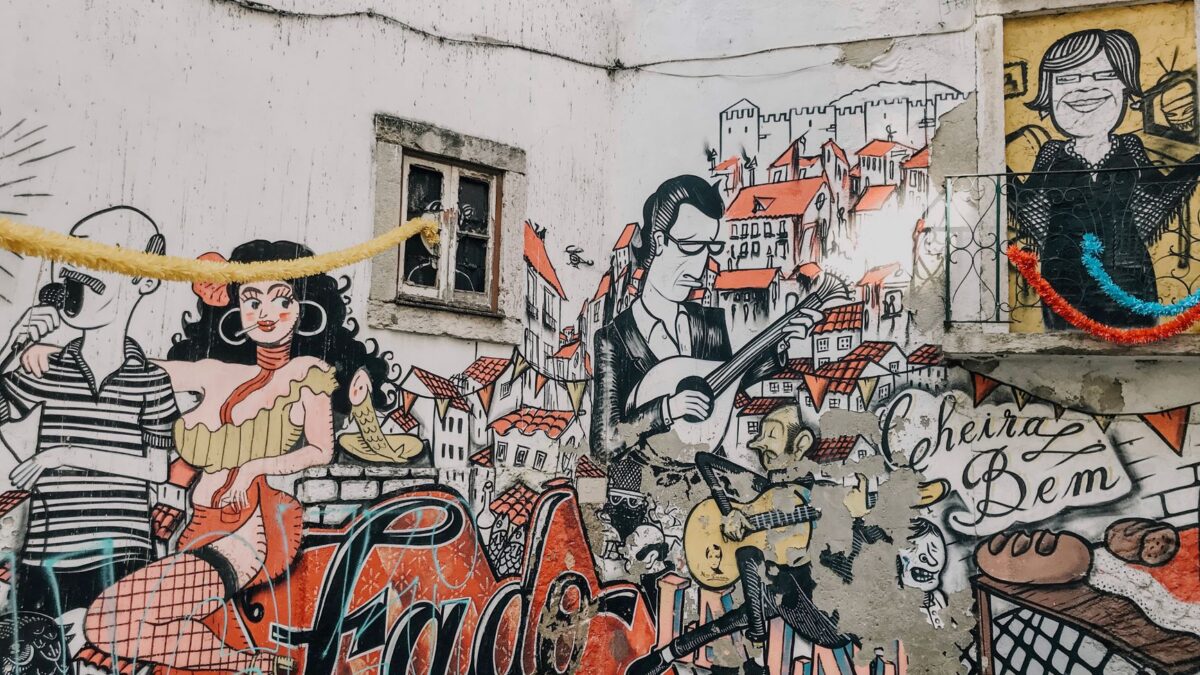
On the Escadinhas de São Cristóvão, the long stairway that links Rua da Madalena with Rua de S. Cristóvão, an artist collective painted “Fado Vadio” across several walls. The mural shows figures and symbols from fado’s history, among them the singers Fernando Maurício and Maria Severa, lines of lyrics, and bread and water set on a table. You reach it about halfway up the steps, and the church of S. Cristóvão stands at the top. Visit Lisboa’s page on the Fado Vadio mural points out that street art does not last forever, so bring a camera.
Amália mural, Rua de São Tomé
On Rua de São Tomé, the urban artist Vhils worked with Lisbon’s cobble pavers on a portrait of the fado singer Amália Rodrigues made from Portuguese cobblestones. The image starts on the pavement and rises up the wall. It was meant as a tribute both to fado, which began in the street, and to the pavers. When it rains, the portrait appears to cry.
Maria Severa’s birthplace, Estrela
Fado’s first remembered singer, Maria Severa Onofriana, was born at number 33 of a street in the parish of Estrela that runs from Travessa do Pasteleiro to Rua das Trinas. The house is signposted. The Real Mosteiro de Nossa Senhora do Mocamba is on the same street.
Sr. Vinho
Sr. Vinho is a fado house owned by the singer Maria da Fé and the poet José Luís Gordo. Inside it looks like a Portuguese family home, with pictures of saints and mementos of fado singers on the walls, and it has hosted fado nights for over 40 years. Our story on the Sr. Vinho anniversary and its founder has more about the house.
The Visit Lisboa fado route describes other houses too. One was opened in 1947 by the bookseller Alfredo de Almeida and the singer Lucília do Carmo, parents of Carlos do Carmo, and Alfredo Marceneiro, Tristão da Silva, Beatriz da Silva and Camané have performed there. Another was opened by Amália Rodrigues in 1968 and is one of the fado houses most popular with foreign visitors, according to Visit Lisboa. A third, a former coal merchant’s and cheap eatery, became a fado landmark in the 1950s under the singer Argentina Santos.
Bairro Alto
Bairro Alto is the starting point of a typical Lisbon night out. Visit Lisboa’s Bairro Alto page describes an evening that begins in its bars and restaurants, drifts down to Bica and ends in Cais do Sodré. By day the quarter has alternative shops selling records and art. A funicular links it with Praça dos Restauradores below, and the Adamastor viewpoint, with a café open 24 hours a day, is nearby beside Bica.
Tips for visiting
- Visit the museum first: it is closed on Mondays, and Lisbon residents can use the free Sunday and holiday mornings until 2 pm.
- Wear good shoes. Alfama and Mouraria are steep, and the São Cristóvão steps are long.
- For fado vadio, look for the small eateries on the square beside the church of S. Miguel in Alfama.
- Combine fado with other old-city sights: our guides to tile museums, churches and facades and history and archaeology museums in Lisbon cover places along the same walks.
Quick answers
How much does the Fado Museum cost?
A standard ticket is 5.00€. Visitors aged 13 to 25 pay 2.50€, seniors over 65 pay 4.00€, and children up to 12 enter free.
Which Lisbon neighborhood is the home of fado?
Alfama and Mouraria. Visit Lisboa calls Mouraria the birthplace of fado and the quarter where Severa lived, while Alfama has the Fado Museum and many fado houses.
What is fado vadio?
Amateur fado sung by whoever wants to sing, often in small eateries. In Alfama, the square beside the church of S. Miguel is a known spot, and Mouraria has a mural named after it.
Is the Fado Museum open on Mondays?
No. It opens Tuesday to Sunday, from 10am to 6pm.
Checked against official sources in November 2026. Hours, prices and rules change: confirm on the official page before you go or apply.
Site editor: Nikita Sheikin