Employment Contracts in Portugal: Fixed-Term Limits, Notice and Leave
The Labour Code sets how long a fixed-term job can last, what a trial period allows and what each side owes when a contract ends. The rules in force after the 2026 reform failed.
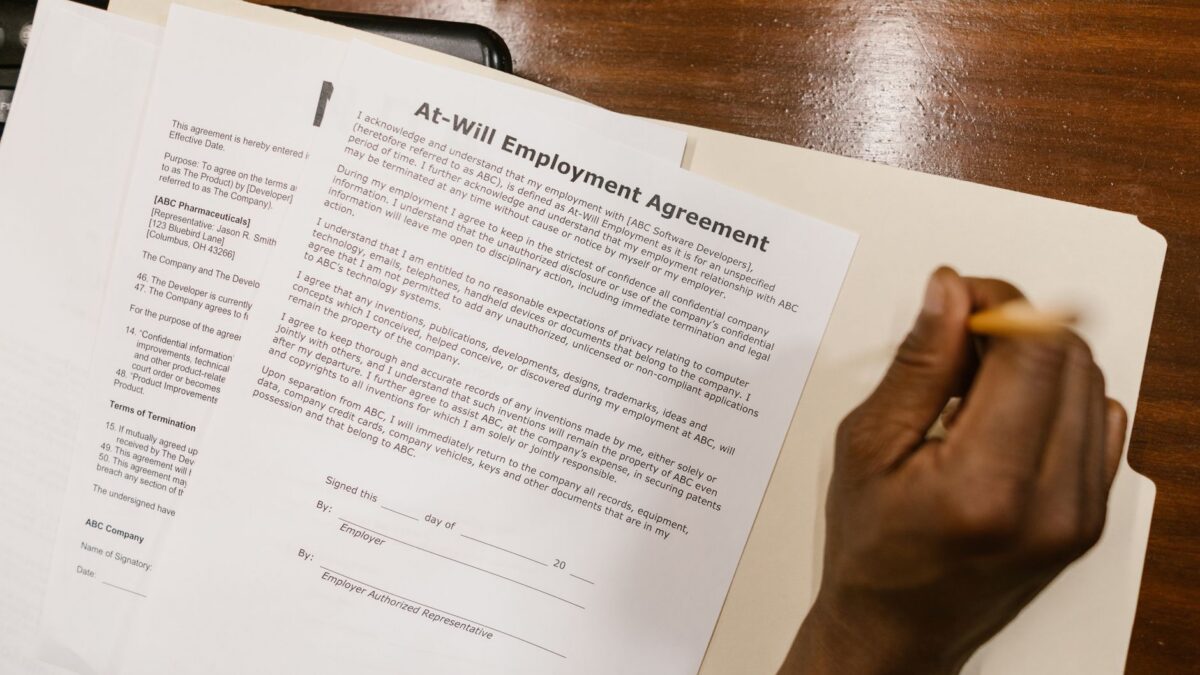
In Portugal, an employment contract is either open-ended or fixed-term. A fixed-term contract with a set end date can last at most 2 years including renewals, and one without a set date at most 4 years. Most open-ended contracts start with a 90-day trial period, every worker gets at least 22 working days of paid leave, and resigning needs 30 or 60 days’ notice.
These rules come from the Labour Code (Código do Trabalho), as amended up to November 2026. A large reform proposed by the government in 2025, known as “Trabalho XXI”, was rejected by parliament in its first vote on 19 June 2026, so the current Code still applies. Collective agreements can improve on several of these rules. For a dispute, speak to the labour inspectorate or a lawyer (advogado).
What types of employment contract are there?
The default is an open-ended contract (contrato sem termo). A fixed-term contract (contrato a termo) is allowed only for a temporary need of the business, such as replacing an absent worker or a seasonal peak, or in specific cases the law lists, and the reason must be written in the contract with concrete facts.
- Fixed term with an end date (termo certo): runs to a date set in the contract and cannot exceed 2 years in total (article 148).
- Fixed term without an end date (termo incerto): lasts as long as the temporary need, such as covering a specific absence, up to 4 years.
Both kinds must be in writing and state the parties, the job and pay, the place and working hours, the start date, and the term or expected duration with its reason (article 141). A fixed-term contract becomes open-ended if it is missing the written form or the reason, if it exceeds the maximum duration or number of renewals, or if the term was used to get around the rules (article 147).
How many times can a fixed-term contract be renewed?
Up to three times, and the renewals together cannot last longer than the first period (article 149). A 6-month contract can therefore be renewed for at most 6 more months in total. If the contract says nothing, it renews automatically for the same period unless one side ends it.
| Rule (as of November 2026) | Limit | Labour Code |
|---|---|---|
| Maximum length, fixed term with end date | 2 years, including renewals | Art. 148(1) |
| Maximum length, fixed term without end date | 4 years | Art. 148(5) |
| Renewals | Up to 3, and no longer in total than the first period | Art. 149(4) |
| Notice of non-renewal | Employer 15 days, worker 8 days before the end | Art. 344(1) |
| Compensation when the employer lets it expire | 24 days of base pay per full year worked | Art. 344(2) |
How long is the trial period?
For open-ended contracts the trial period (período experimental) is 90 days for most workers, 180 days for complex or high-responsibility roles, positions of trust, first-job seekers and the long-term unemployed, and 240 days for directors and senior managers (article 112). For fixed-term contracts it is 30 days if the contract lasts 6 months or more, and 15 days if shorter.
Either side can end the contract during the trial period without notice, reason or compensation. But after 60 days of trial the employer must give 7 days’ notice, and after 120 days, 30 days’ notice (article 114). Time already worked for the same employer on an earlier fixed-term contract, temp contract or internship for the same job reduces or removes the trial period.
How much annual leave do I get?
At least 22 working days a year, Monday to Friday, not counting public holidays (article 238). Collective agreements or the contract can give more. Leave comes with a holiday allowance, part of the 14 salary payments a year; see our guide to the holiday and Christmas subsidies. Public holidays are listed in our public holidays guide.
How much notice do I give, and when is compensation due?
A worker can resign without giving a reason by writing to the employer with 30 days’ notice if they have up to 2 years of service, or 60 days if more (article 400). On a fixed-term contract, the notice is 30 days if the contract lasts 6 months or more, and 15 days if shorter. A contract or collective agreement can extend notice to up to 6 months for managers.
An employer cannot dismiss at will. The Labour Code allows dismissal for just cause after a disciplinary procedure, or for objective reasons such as collective dismissal, job elimination or unsuitability, each with its own procedure.
| How the contract ends (as of November 2026) | Notice from employer | Compensation |
|---|---|---|
| Collective dismissal or job elimination | 15 days (under 1 year of service), 30 days (1 to 5), 60 days (5 to 10), 75 days (10 or more) | 14 days of base pay per full year, with caps |
| Fixed-term contract not renewed by the employer | 15 days | 24 days of base pay per full year |
| Dismissal ruled unlawful by a court | Not applicable | Reinstatement, or 15 to 45 days of pay per year instead, at least 3 months’ pay |
The 14-day compensation is capped: monthly pay above 20 times the minimum wage is not counted, and the total cannot exceed 12 months’ pay (article 366). Our guide to the minimum wage gives the current amount.
Where can I complain about my employer?
The labour inspectorate, ACT (Autoridade para as Condições do Trabalho), handles complaints about unpaid wages, illegal contracts, working hours and safety. You can reach it through the ACT website or at one of its local offices.
- Collect your contract, payslips (recibos de vencimento), messages and a record of hours worked.
- Raise the problem in writing with the employer first, and keep a copy.
- File the complaint with ACT, which can inspect and fine employers.
- For dismissal disputes or unpaid compensation, a labour lawyer or your union can advise; claims go to the labour courts, and some deadlines are short.
Bottom line
A fixed-term contract that has no written reason, or that has run past its limits, is legally an open-ended one, which matters most when the employer tries to let it lapse. Keep copies of every contract and renewal: the dates and the stated reason are what a court or ACT will look at first.
FAQ
Can my employer end my contract during the trial period?
Yes, without a reason or compensation. After 60 days of trial they must give 7 days’ notice, and after 120 days, 30 days’ notice.
Does a contract have to be in Portuguese?
The Labour Code requires fixed-term contracts to be in writing with set content. Many international employers issue bilingual contracts; if you sign one in a language you do not read, ask for a translation first.
Am I entitled to compensation if I resign?
No, resignation with notice does not give compensation. You are still owed pay up to your last day and the amounts already earned for leave and the holiday and Christmas subsidies.
Did the 2026 labour reform change these rules?
No. The government’s “Trabalho XXI” bill was rejected in its first parliamentary vote on 19 June 2026, so the rules above remain in force.