British Residents at Lisbon Passport Control: EES and Residence Cards
British residents of Portugal are exempt from the EES if they show a residence card at passport control. How to use it, renew it and fix a wrong record.

British citizens who live in Portugal and hold a residence card are exempt from the EU’s Entry/Exit System (EES), and the card is what proves it at the border. UK government guidance tells exempt travellers to skip EES registration and hand their exempting documentation to a border guard on arrival. Short-stay visitors on a UK passport may be asked for fingerprints and a photo.
What is the EES and who has to register?
The EES is the EU’s digital border system for the Schengen area, which includes Portugal. It started on Oct. 12, 2025. According to the UK government’s EES guidance, anyone entering a Schengen country for a short stay on a UK passport may have to register biometric details, such as fingerprints and a photo, when they arrive. On a first visit this can happen at a dedicated booth before the immigration desk.
Registration is free and travellers do nothing before they reach the border. The digital record is valid for 3 years and replaces the manual passport stamp that visitors used to get. Children aged 11 or younger do not have their fingerprints scanned, although they can be required to have a photo taken. Visitors may also be asked for a fingerprint or photo when they leave.
Are British residents of Portugal exempt?
Yes. The UK travel advice for Portugal says that a long-term resident of a Schengen country is exempt from the EES in all Schengen countries. The exemption therefore covers a return flight to Lisbon and a trip from Portugal to any other Schengen state. The full list of exemptions is on the EU’s official Travel Europe website.
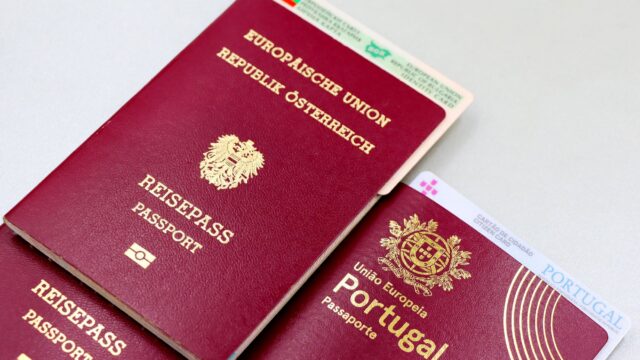
The same advice asks exempt travellers to carry documentation that confirms their status. For a British resident of Portugal, that document is the residence card issued by AIMA (Agência para a Integração, Migração e Asilo, Portugal’s immigration agency).
What should you show at passport control in Lisbon?
Show your passport together with your residence card. The UK guidance sets out a short routine for exempt travellers:
- Keep your passport and residence card in your hand luggage and take both out before you reach the border.
- Do not register for the EES. The guidance says exempt travellers should not register.
- Give the residence card to the border guard as your exempting documentation.
- Follow the directions of airport staff, and tell border staff if you expect a problem.
Queues can be longer than before because EES checks take each visitor extra time. Our article on EES registration and the passport hall at Lisbon airport describes the process visitors go through.
What happens if an EES record is created for you by mistake?
The record should be deleted afterwards. The UK guidance says a border guard can normally do this at the border, or the relevant authorities inside the Schengen area can. Some records are deleted automatically, for example when a traveller receives a residence permit after entering the Schengen area.
If you think you were wrongly entered into the EES, or that your recorded time in the Schengen area is wrong, speak to border officials the next time you cross the Schengen border and ask for a correction. Bring your residence card, and be ready to give supporting evidence if they ask for it.
A wrong record is worth correcting because the EES automates the checks that catch visitors who overstay. Visitors on a UK passport can stay up to 90 days in any 180-day period, and overstaying can lead to a ban from Schengen countries for up to 3 years. Residents are not counted this way, as our guide to the Schengen 90/180 day rule in Portugal explains.
Which residence card do you need, and how do you keep it valid?
The card depends on when you moved. The UK government’s Living in Portugal guide says that people who moved before Jan. 1, 2021, and have lived legally in Portugal since then, have rights under the Withdrawal Agreement and should hold a Withdrawal Agreement residence permit. Anyone in that group without the card must get one now by emailing AIMA at [email protected] with proof of their time in Portugal. If AIMA asks for more documents, reply within 10 working days.
A successful application leads to an appointment at an AIMA office to give biometric data, and the card then arrives by post. Take to the appointment:
- your valid passport
- proof of address
- the original of your EU residency documentation, if you have it
- your NIF (fiscal number)
- your NNU (número nacional de utente, the health number)
- your NISS (social security number), if you have one
People who arrived later become residents by entering Portugal on a residence visa and applying for a residence card after arrival. AIMA handles both.
Cards expire. A temporary residence card has to be renewed every 2 to 3 years and a permanent residency document every 5 years. Withdrawal Agreement holders can apply after 5 years of residence for a permanent card valid for 10 years. Tell AIMA if your address, email or name changes, because some changes require a new card.
If the card is lost or stolen, report it to the police first and ask for a copy of their report, then contact AIMA for a replacement. Carrying a valid residence document is a legal requirement in Portugal. The police may ask to see it, and you may be fined if you cannot show it.
Will residents need ETIAS as well?
No, as long as they hold a residence permit. ETIAS (the European Travel Information and Authorisation System) is a separate travel authorisation that the UK guidance says the EU is expected to start operating from autumn 2026, with the launch date to be announced by the EU. It will apply to people using a UK passport who do not already have a visa or residence permit, and it will cost 20 euros. Websites that sell ETIAS before the launch are fraudulent, according to the guidance.
Quick answers
Does the exemption also apply when leaving Lisbon?
Yes. Long-term residents are exempt from the EES in all Schengen countries, so carry the residence card with your passport on departure as well as on arrival.
Can the British Embassy help with a residence card?
No. The British Embassy in Lisbon and the British Vice Consulate in Portimão cannot help with Portuguese visa and residency applications. Contact AIMA, the Portuguese consulates in London and Manchester, or an English-speaking lawyer in Portugal.
What about dual citizens of the UK and an EU country?
The UK government says dual citizens of the UK and an EU country should register their residency in Portugal with their European nationality.
Checked against official sources in November 2026. Hours, prices and rules change: confirm on the official page before you go or apply.
Site editor: Nikita Sheikin